Voltage Required
Watts cannot be converted to amps without voltage.

This Watts to Amps calculator — the free Watt and Ampere Calculator — converts electrical power in watts to current in amps using voltage and, for AC circuits, power factor and phase configuration. Switch direction to calculate watts from amps.
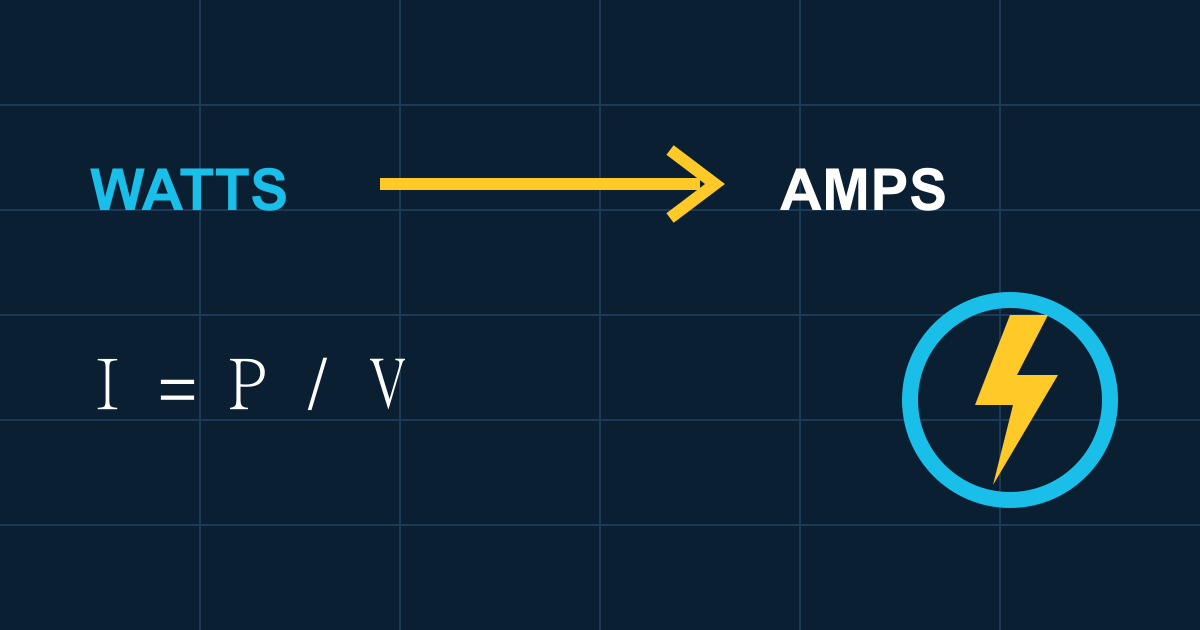
Quick answer: for DC, amps equal watts divided by volts. AC calculations also use power factor and, for balanced three-phase circuits, the square root of three.
Power factor varies by load. Use the equipment value when available.
I = P / VCustom voltage is always supported.
Watts cannot be converted to amps without voltage.
AC loads may require a power factor between 0 and 1.
The selected electrical system determines the correct formula.
Results update as you change the electrical parameters.
For a fixed 1,000 W DC load, higher voltage means lower current.
Enter watts or amps.
Choose DC, single-phase AC, or three-phase AC.
Enter the circuit voltage.
For AC, add power factor and read the result.
The same calculator reverses the equation to determine watts from amps.
I = P / VI = P / (V × PF)I = P / (√3 × V × PF)P = V × IP = V × I × PFP = √3 × V × I × PFI = 1,200 / 120 = 10 AI = 1,200 / (120 × 0.8) = 12.5 AI = 16.0375 AThese values use DC at the selected voltage. They are not universal watt-to-amp conversions.
| Watts (W) | Volts (V) | Amps (A) |
|---|---|---|
| 10 | 120 | 0.083333 |
| 25 | 120 | 0.208333 |
| 50 | 120 | 0.416667 |
| 100 | 120 | 0.833333 |
| 200 | 120 | 1.6667 |
| 500 | 120 | 4.1667 |
| 750 | 120 | 6.25 |
| 1000 | 120 | 8.3333 |
| 1500 | 120 | 12.5 |
| 2000 | 120 | 16.6667 |
| 3000 | 120 | 25 |
| 5000 | 120 | 41.6667 |
Measures electrical power, or the rate of electrical energy transfer.
Measures electric current flowing through a circuit.
Measures electrical potential difference and connects watts with amps.
| Quantity | Unit | Symbol | Represents |
|---|---|---|---|
| Power | Watt | W | Rate of electrical energy transfer |
| Current | Ampere | A | Electric current |
| Voltage | Volt | V | Electrical potential difference |
DC uses P = V x I. AC real-power calculations can also require power factor and phase configuration.
DC: I = P / VFor a balanced three-phase system using line-to-line voltage, the formula includes sqrt(3). Real installations can require additional engineering analysis.
3φ: P = √3 × V × I × PFThere is no universal answer because voltage is required. At 1 V DC it is 1 A; at 12 V it is about 0.0833 A; at 120 V it is about 0.00833 A.
Voltage is required. In DC, 1 A at 12 V is 12 W, at 120 V is 120 W, and at 230 V is 230 W.
Multiply current by voltage for DC. For AC, also multiply by power factor and, for balanced three-phase line voltage, by sqrt(3).
Switch to Amps to WattsFor the same power, increasing voltage reduces current in these DC examples.
Power factor relates real power in watts to the voltage-current product. A lower power factor requires more current for the same real power.
Choose the electrical system, enter watts and voltage, and add power factor for AC. The calculator applies the matching formula.
It depends on voltage and system. At 120 V DC, 100 W is about 0.8333 A.
At 120 V DC, 1000 W is about 8.333 A. AC answers can differ because of power factor and phase.
No. Voltage is required to relate electrical power to current.
There is no fixed value. In DC, watts equal volts multiplied by amps.
Yes. For the same AC real power and voltage, a lower power factor produces a higher calculated current.
Use the value supplied for the equipment or measured for the load. If unknown, do not assume every load has a power factor of 1.
Amps equal watts divided by volts: I = P / V.
For real power, amps equal watts divided by volts times power factor: I = P / (V x PF).
For a balanced system using line-to-line voltage: I = P / (sqrt(3) x V x PF).
Because current is power divided by voltage in DC and corresponding PF-adjusted AC formulas.
Not necessarily. AC calculations may include power factor and phase configuration.
Enter the voltage for the circuit or equipment. For this three-phase formula, use line-to-line voltage.
Yes. It supports balanced three-phase real-power calculations using line-to-line voltage and power factor.
The calculator formulas and definitions are presented alongside these independent measurement and electrical-engineering references.